From induction to recovery, perioperative care demands complete control over gas delivery and waste capture. Pneumotronics provides a full ecosystem that includes precise gas blending for anaesthesia workstations, active scavenging for staff protection, and continuous monitoring from the operating theatre to the PACU. This creates an environment where anaesthetists can focus entirely on the patient while the infrastructure manages every inspired and expired gas in silent coordination.
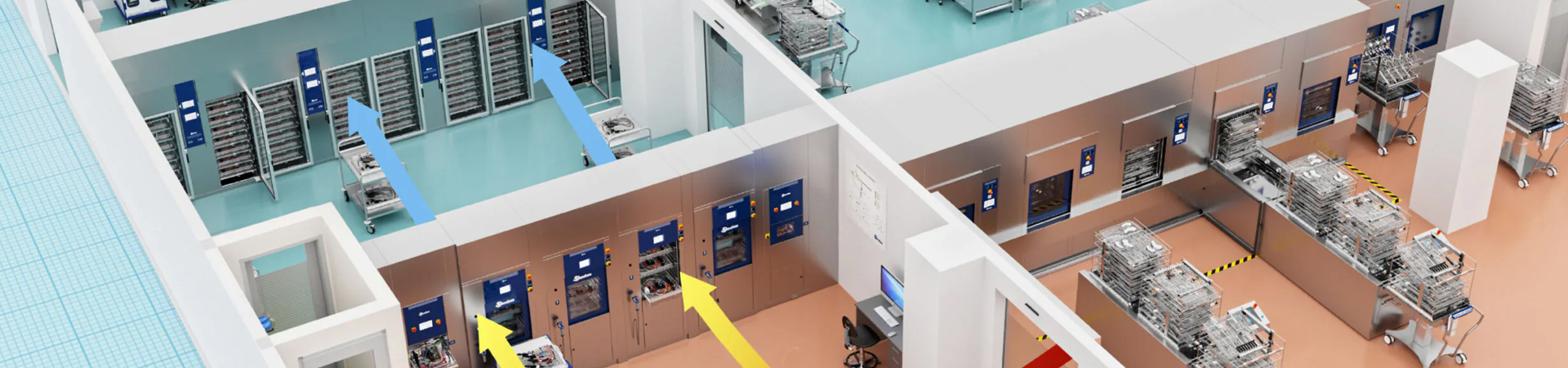
Pneumotronics designs a dedicated gas loop for the surgical suite, isolated from the general hospital network to ensure uninterrupted supply. The loop uses 28 mm copper as the primary ring main with 15 mm branches to each theatre, maintaining stable pressure even during simultaneous use.
Each theatre includes two Ceiling Pendants, one over the surgical field and one over the anaesthesia workstation. The anaesthesia pendant includes four oxygen outlets, four medical air outlets, and four vacuum outlets arranged in a logical, color coded layout.
In the PACU, Bed Head Units provide oxygen, air, and vacuum for recovery, with additional flowmeters for oxygen titration and humidifiers for prolonged therapy.
Technical Note: The OR gas loop should be pressure tested annually at 1 point 5 times working pressure. Pressure decay above 2 percent over 24 hours indicates a leak. PACU units should allow access from both sides of the bed.
Pneumotronics supplies Oxygen and Air Blenders for anaesthesia workstations, providing accurate gas mixing for volatile agent delivery and ventilation. Blenders support up to 120 L per min flow with plus or minus 2 percent FiO2 accuracy and a response time under 1 second.
In the PACU, stand alone blenders with digital FiO2 displays and alarms are integrated into each Bed Head Unit.
Oxygen Flowmeters with integrated humidifiers support nasal cannula and mask therapy. The bubble humidifier provides 12 hours of operation at 5 L per min.
Technical Note: Blenders should be tested at installation and annually using a paramagnetic oxygen analyzer at 30, 50, and 100 percent FiO2 at 10, 30, and 60 L per min. PACU blenders require a 4 hour battery backup for alarm continuity.
Pneumotronics installs a dedicated Anaesthesia Gas Scavenging System using a central pump separate from the medical vacuum system. The pump maintains 50 to 150 Pa negative pressure at each theatre interface with 100 L per min capacity per theatre.
Each theatre includes a scavenging interface on the ceiling pendant with a 32 mm collection line, a visible flow indicator, and an audible failure alarm.
The system is monitored by the Medical Gas Alarm Unit for the surgical suite, which alerts staff if negative pressure falls below 30 Pa or if the exhaust fan fails.
Technical Note: Scavenging lines should be checked monthly with a calibrated flow meter. Exhaust must vent outdoors at least 5 meters from any air intake.
Pneumotronics installs Medical Gas Alarm Units at each theatre entrance and at the anaesthesia control desk. Units display oxygen, air, and vacuum pressure with visual and audible alerts. A 10 second delay filters out transient drops.
The Central Gas Monitoring System provides a consolidated view of all perioperative areas, integrated with the Network Nurse Master Station. High priority alarms such as oxygen loss or scavenging failure trigger red alerts throughout the suite.
In the PACU, an Oxygen Depletion Monitor is installed at 1 point 5 meters height with warning at 19 point 5 percent and critical alert at 18 percent. The monitor is interlocked with ventilation to increase air exchange automatically.
Technical Note: Alarm units must be visible from the anaesthesia workstation and mounted at 1 point 6 meters. The surgical suite schematic should be reviewed annually. Integration with the nurse call system allows anaesthesia alarms to appear on the nurse station master unit for rapid coordination.
Subscribe to precision-fueled care and holistic safety intelligence from our Medical Gas Ecosystem. Elevate patient outcomes across every clinical zone with integrated, life-support clarity.
© Nortek HealthCare Group Ltd., 2009-2026. All rights reserved.
This site operates under the laws of the People's Republic of China. Your access and use constitute acceptance of these Terms of Use and our Privacy Policy. All content is governed by our Privacy Notice. For details or inquiries, please Contact Us or use the site's search function.